

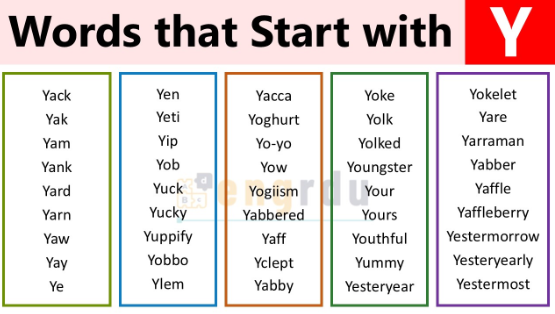
The English language is a rich tapestry of letters, sounds, and meanings. Among its 26 letters, Y holds a unique place. It functions as both a vowel and a consonant, which gives it a versatile role in words. This dual nature makes “Y words” fascinating, as they appear in various contexts, from everyday vocabulary to specialized scientific terminology. In this article, we will explore the types of Y words, their uses, significance, and examples, providing a comprehensive understanding of this distinctive letter.
The Role of Y as a Consonant
When Y appears at the beginning of a word, it typically functions as a consonant. In this role, it produces the “yuh” sound, as in “yes” or “yarn.” This consonantal Y often signifies action, youthfulness, or a dynamic quality in words. Consonantal Y is particularly common in verbs and nouns, creating a sense of movement or liveliness.
For example, words like yell, yawn, yield, and yodel begin with Y as a consonant. Each of these words carries a strong auditory or physical action: yelling involves a vocal sound, yawning involves a bodily movement, yielding implies submission or giving way, and yodeling is a musical call. The consonantal Y is also prominent in proper nouns such as names (Yvonne, Yusuf) and geographical locations (York, Yakutat).
The Role of Y as a Vowel
Y can also function as a vowel, often appearing in the middle or at the end of a word. When Y serves as a vowel, it commonly represents the long “ee” sound, as in happy, or the short “i” sound, as in myth. This flexibility allows Y to contribute to the rhythm, rhyme, and phonetic diversity of English words.
For example, gym, mystery, and rhythm all use Y as a vowel. In gym, Y takes the place of the short “i” vowel, while in mystery, it provides a melodic sound that stretches the syllable. Words like candy, hobby, and puppy illustrate Y as a final vowel, giving the words a softer, more playful tone. This vowel usage is especially significant in poetry and literature, where the sound and flow of words enhance expression.
Common Y Words in Everyday Use
Many Y words are part of our everyday vocabulary. These words span a wide range of categories, including emotions, actions, and descriptions. Examples include:
- Youth: Represents the stage of being young, often associated with energy, curiosity, and growth.
- Year: A fundamental unit of time, essential in calendars, planning, and life events.
- Yes: A simple yet powerful affirmative response used universally.
- Yard: Refers to an outdoor space, often used in measurement or gardening contexts.
- Yellow: A primary color often associated with sunlight, warmth, and cheerfulness.
These words are not only common but also culturally significant. For instance, youth is often a central theme in literature, education, and social discussions, while yes is foundational in communication, shaping agreements and decisions.
Scientific and Technical Y Words
Y words are also prominent in scientific and technical fields. These terms often carry precise meanings and are crucial in specialized disciplines. Some examples include:
- Yttrium: A chemical element with the symbol Y, used in electronics, lasers, and various alloys.
- Yield: In agriculture and finance, it refers to production or return, indicating efficiency and output.
- Yeast: A microorganism used in baking and fermentation, essential for producing bread, beer, and wine.
- Yttrium-aluminum-garnet (YAG): A crystal used in lasers and optical equipment.
These Y words illustrate the letter’s versatility in technical language, where clarity and specificity are paramount. Y words often carry symbolic or literal weight in their respective fields, making them indispensable in professional communication.
Y Words in Names and Places
The letter Y is common in proper nouns, including names of people, brands, and locations. Names like Yasmine, Yosef, and Yuri reflect cultural diversity and heritage. In geography, Y words include Yemen, Yukon, and Ypres, highlighting the global presence of this letter.
Brands and companies also utilize Y words for their distinctive sound and memorability. For instance, Yahoo and Yamaha demonstrate how Y adds uniqueness and recognition to brand identity. This usage capitalizes on the visual and phonetic appeal of the letter, making Y words stand out in a crowded linguistic landscape.
Emotional and Expressive Y Words
Many Y words convey emotions, attitudes, or expressive states. They are powerful in storytelling, dialogue, and creative writing. Examples include:
- Yearning: A deep longing or desire, often used in poetry and literature.
- Yelp: A sudden, sharp cry expressing pain, surprise, or excitement.
- Yuck: An exclamation of disgust or distaste.
- Yippee: An expression of joy or excitement.
These words illustrate how Y contributes to emotional nuance in language. The letter’s sharp, distinct sound often amplifies the intensity of feelings, making it a favorite in expressive writing and casual speech.
Y Words in Idioms and Phrases
Y words frequently appear in idioms, proverbs, and common expressions, enriching the language with imagery and wisdom. Some examples include:
- You reap what you sow: A proverb emphasizing consequences of actions.
- Your guess is as good as mine: Indicates uncertainty or shared lack of knowledge.
- Young at heart: Describes someone who maintains youthful enthusiasm despite age.
These phrases demonstrate how Y words integrate seamlessly into the fabric of language, adding depth, rhythm, and cultural resonance.
Y Words in Literature and Media
In literature, Y words often carry symbolic meanings. Words like yearning, yonder, and youthful evoke imagery, emotion, and themes of aspiration, distance, and vitality. Poets and authors use these words to enhance narrative texture, create rhyme schemes, and convey subtle emotional undertones.
In media, Y words frequently appear in titles, slogans, and dialogue. For instance, the word Yonder might evoke a sense of adventure or mystery, while Yay and Yikes express immediate reactions that readers or viewers can relate to. The phonetic appeal of Y often makes such words memorable and engaging in both written and spoken forms.
Challenges and Curiosities with Y Words
Despite their versatility, Y words can be tricky for learners of English. Since Y can be both a vowel and a consonant, its pronunciation depends on context. For example, yes uses Y as a consonant, whereas myth uses it as a vowel. Spelling rules can also be confusing, particularly when forming plurals or verb conjugations.
Another curiosity is that Y words often appear in scientific or technical lexicons, which can make them seem unfamiliar or intimidating. Words like yttrium or yottabyte (a massive unit of digital information) may require extra effort to understand and pronounce. This dual challenge highlights the importance of context and practice when mastering Y words.
Y Words in Modern Culture and Technology
In contemporary culture, Y words have found new relevance. Social media platforms and technology brands often adopt Y words for their catchy appeal. Examples include:
- YouTube: A platform where Y immediately signals the personalized “you” experience.
- Yelp: An online review site whose name reflects quick, sharp feedback.
- Yolo (You Only Live Once): A popular acronym capturing modern attitudes toward risk and enjoyment.
These usages underscore how Y words continue to evolve with cultural trends, technology, and communication habits, demonstrating linguistic adaptability.
Fun Facts About Y Words
- Rare but impactful: Y is one of the least frequently used letters in English but carries significant influence when it appears.
- Dual identity: Its role as both vowel and consonant makes Y uniquely versatile.
- Phonetic charm: Many Y words have a playful or expressive sound, enhancing their memorability.
- Global presence: Y words appear in names, places, and languages worldwide, reflecting cultural diversity.
Understanding these characteristics can help learners, writers, and enthusiasts appreciate the subtle power of Y words in shaping communication.
Conclusion
Y words are an integral part of the English language, showcasing flexibility, expressiveness, and cultural significance. Whether functioning as a consonant or a vowel, appearing in everyday vocabulary, technical jargon, literature, or media, Y words enrich communication with their distinctive sound and meaning. Their role in emotion, identity, and cultural expression makes them fascinating to study and essential to master. By exploring the various types, uses, and nuances of Y words, we gain deeper insight into the richness and versatility of English.
FAQs
Q1: Can Y function as both a vowel and a consonant in the same word?
A1: Yes, though it is rare. Typically, Y at the start of a word is a consonant, while Y in the middle or end acts as a vowel. Some complex words or compound forms may demonstrate both roles in different syllables.
Q2: Are there any famous scientific Y words?
A2: Yes, examples include yttrium, yeast, and yottabyte, all of which are significant in chemistry, biology, and technology.
Q3: How can learners remember Y’s vowel and consonant roles?
A3: A useful tip is to observe its position: Y at the beginning usually sounds like “yuh” (consonant), and Y at the end or middle often has an “ee” or “i” sound (vowel).
Q4: Why do Y words often feel playful or expressive?
A4: The phonetic quality of Y—its sharp, distinct, and sometimes elongated sound—adds expressiveness, making words like yippee, yuck, and yawn memorable and engaging.
Q5: Are Y words common in proper nouns and brands?
A5: Yes, many names, locations, and brands use Y to stand out visually and phonetically, such as Yahoo, Yosef, and Yamaha.

